
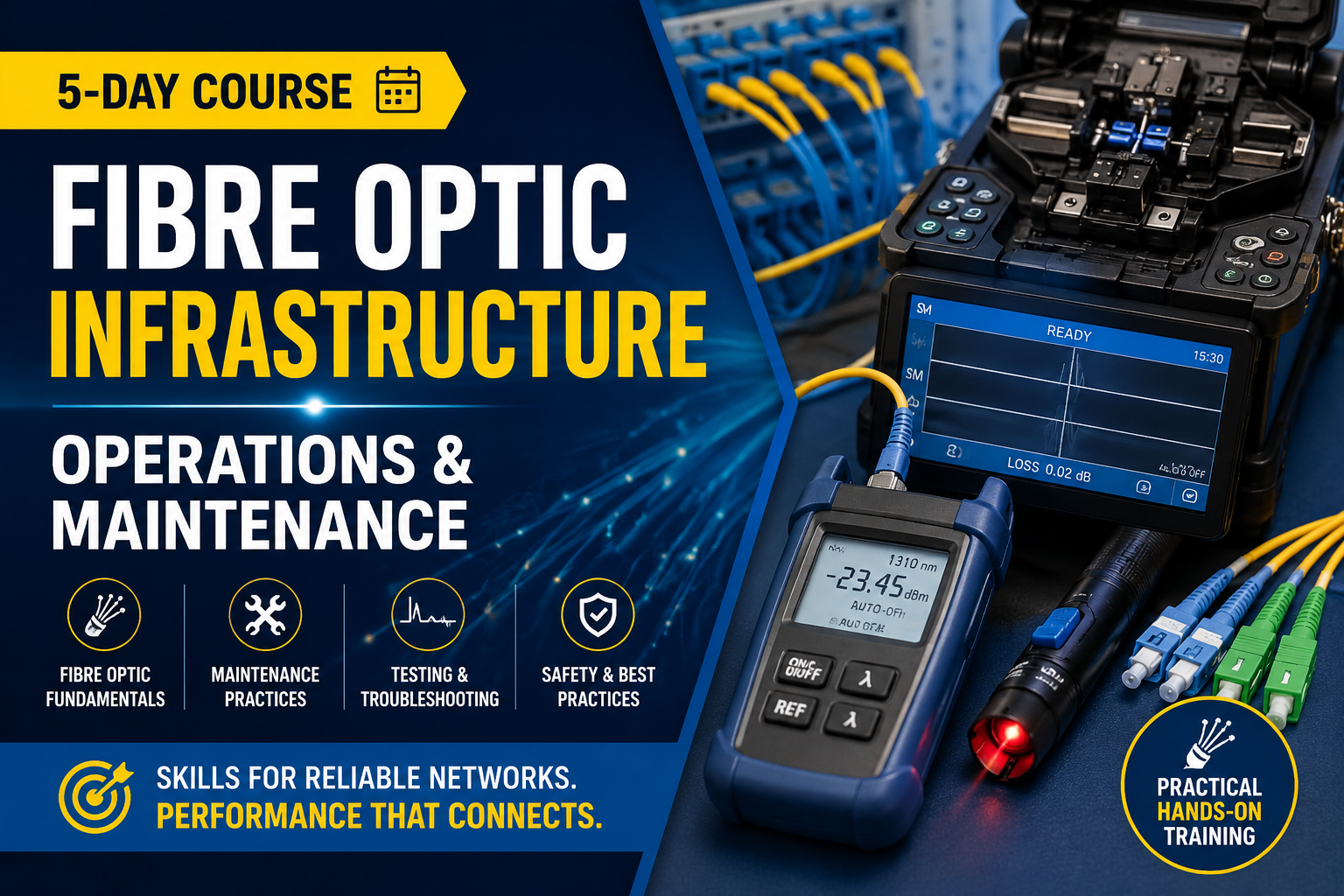
This intensive 5-day course is designed to equip participants with the technical knowledge and practical skills required to operate, maintain, troubleshoot, and optimize fibre optic infrastructure. The course covers the fundamentals of fibre optic communication systems, network components, maintenance procedures, fault detection techniques, testing methodologies, and industry best practices for ensuring reliable network performance.
Participants will gain hands-on experience using essential fibre optic testing and maintenance tools, including Optical Time Domain Reflectometers (OTDR), Optical Power Meters (OPM), Visual Fault Locators (VFL), and fusion splicers. Emphasis is placed on preventive maintenance, fault diagnosis, network restoration, safety procedures, and documentation to ensure minimal downtime and maximum service availability.
Upon completion, participants will be capable of carrying out routine maintenance activities, identifying and resolving fibre network faults, interpreting test results, and supporting the continuous operation of fibre optic communication networks.
Learning Objectives
By the end of this course, participants will be able to:
- Understand the principles of fibre optic communication systems.
- Identify fibre optic cables, connectors, closures, splitters, and network components.
- Apply health, safety, and environmental (HSE) requirements when working with fibre infrastructure.
- Perform preventive and corrective maintenance on fibre optic networks.
- Use OTDR, OPM, and VFL equipment for testing and troubleshooting.
- Conduct fibre splicing, termination, and restoration activities.
- Detect, isolate, and resolve common fibre optic faults.
- Interpret test results and prepare maintenance reports.
- Implement best practices for network reliability and service continuity.
Target Audience
- Fibre Optic Technicians
- Telecommunications Engineers
- ICT Professionals
- Network Support Engineers
- Broadband Infrastructure Personnel
- Maintenance Technicians
- Technical Operations Staff
Course Duration
Course Outline
Day 1: Introduction to Fibre Optic Infrastructure
- Fundamentals of Fibre Optic Communication
- Types of Fibre Optic Cables
- Network Architecture and Components
- Fibre Optic Standards and Best Practices
- Health, Safety, and Environmental Requirements
Day 2: Fibre Optic Installation and Maintenance Fundamentals
- Cable Routing and Protection Methods
- Fibre Closures, Patch Panels, and Distribution Frames
- Inspection Procedures
- Preventive Maintenance Techniques
- Maintenance Documentation and Reporting
Day 3: Fibre Testing and Measurement
- Introduction to Fibre Testing Equipment
- Optical Power Meter (OPM) Operations
- Visual Fault Locator (VFL) Usage
- OTDR Testing Principles and Applications
- Interpreting Test Results
Day 4: Fault Detection and Network Restoration
- Common Fibre Network Faults
- Troubleshooting Methodologies
- Fibre Splicing Techniques
- Emergency Restoration Procedures
- Practical Fault-Finding Exercises
Day 5: Network Performance Optimization and Practical Assessment
- Network Monitoring and Performance Management
- Quality Assurance Procedures
- Maintenance Planning and Scheduling
- Practical Assessment
- Review, Evaluation, and Certification
Expected Outcomes
Upon successful completion of the course, participants will be able to independently maintain fibre optic infrastructure, perform diagnostic testing, execute network restoration activities, and contribute effectively to the reliability and availability of fibre optic communication networks. This course prepares participants for operational and maintenance roles within telecommunications, broadband, enterprise networking, and ICT infrastructure environments.