
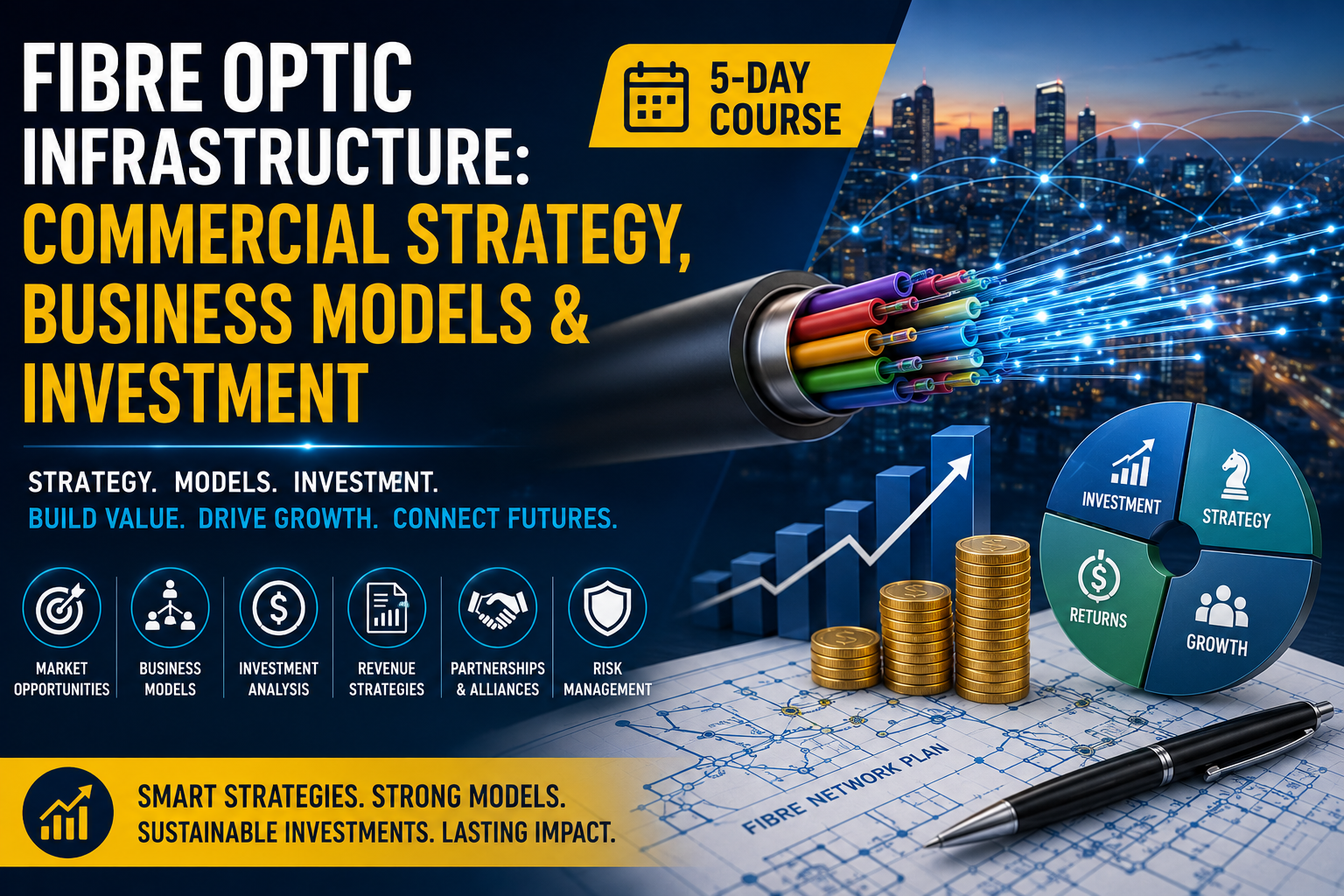
This intensive 5-day professional training programme is designed to equip participants with the strategic, commercial, and financial knowledge required to successfully develop, invest in, and manage fibre optic infrastructure projects. The course explores the commercial aspects of fibre network deployment, including business model design, market opportunity assessment, investment analysis, revenue generation strategies, and long-term sustainability.
Participants will gain practical insights into the economics of fibre infrastructure, demand forecasting, market positioning, partnership models, financing options, and investment decision-making. The programme examines how fibre operators, infrastructure companies, investors, governments, and telecommunications providers can create value through effective commercial strategies and innovative business models.
Through real-world case studies and industry best practices, participants will learn how to evaluate investment opportunities, develop bankable business cases, assess project viability, manage risks, and maximize returns on fibre infrastructure investments.
Learning Objectives
By the end of this course, participants will be able to:
- Understand the commercial landscape of fibre optic infrastructure.
- Analyze market opportunities and demand drivers for broadband services.
- Develop sustainable business models for fibre infrastructure projects.
- Evaluate various revenue-generation and monetization strategies.
- Conduct financial and investment analysis for fibre projects.
- Assess project risks and mitigation strategies.
- Develop commercial strategies for network expansion and growth.
- Structure partnerships, joint ventures, and infrastructure-sharing agreements.
- Prepare business cases and investment proposals.
- Measure project performance and return on investment (ROI).
Target Audience
- Telecommunications Executives
- Infrastructure Investors
- Business Development Managers
- Project Managers
- Regulatory and Policy Professionals
- Financial Analysts
- ICT Infrastructure Professionals
- Government Agencies and Development Partners
- Entrepreneurs in the Telecommunications Sector
Course Duration
Course Outline
Day 1: Fibre Infrastructure Market and Commercial Fundamentals
- Overview of Fibre Optic Infrastructure Ecosystem
- Industry Trends and Market Dynamics
- Broadband Demand Analysis
- Fibre Infrastructure Value Chain
- Commercial Opportunities and Challenges
Day 2: Business Models for Fibre Infrastructure
- Open Access Networks
- Wholesale and Retail Models
- Dark Fibre and Managed Services Models
- Infrastructure Sharing Strategies
- Public-Private Partnership (PPP) Models
- Case Studies of Successful Fibre Businesses
Day 3: Investment Planning and Financial Analysis
- Capital Expenditure (CAPEX) and Operating Expenditure (OPEX)
- Revenue Forecasting Techniques
- Financial Modelling for Fibre Projects
- Investment Appraisal Methods
- ROI, NPV, IRR, and Payback Analysis
- Funding and Financing Sources
Day 4: Commercial Strategy and Risk Management
- Market Entry and Expansion Strategies
- Customer Acquisition and Retention Models
- Pricing and Revenue Optimization
- Competitive Positioning
- Risk Assessment and Mitigation
- Regulatory and Policy Considerations
Day 5: Business Case Development and Investment Decision-Making
- Developing Bankable Fibre Infrastructure Projects
- Investor Pitch Development
- Partnership and Stakeholder Management
- Performance Measurement and KPIs
- Group Case Study and Practical Exercise
- Course Assessment and Action Planning
Expected Outcomes
Upon successful completion of this course, participants will be able to develop commercially viable fibre optic infrastructure projects, evaluate investment opportunities, create sustainable business models, and formulate strategies that maximize network utilization, profitability, and long-term growth. They will be equipped to make informed investment decisions and contribute effectively to the expansion of broadband infrastructure and digital connectivity initiatives.